


Unpolished Kodo Millet
Unpolished Kodo Millet
Regular price
₹297.00
Regular price
₹342.00
Sale price
₹297.00
Shipping calculated at checkout.
Best Price
₹287
with coupon
Quantity
Couldn't load pickup availability
Product Description
Light, easy to digest, and naturally calming on the stomach, Kodo millet is the perfect grain to start with if you're new to millets. Cooks like rice. Adapts to almost any recipe. Unpolished so the bran, fibre, and nutrition stay fully intact. Naturally gluten-free, low glycemic, and gentle enough for daily use.
 View full details


Unpolished. Unrefined. Untouched.


Key Benefits:
Faqs
Yes. Kodo millet has a low glycemic index, helps control blood sugar levels, and is widely recommended in diabetic-friendly diets.
Yes, Kodo millet is naturally 100% gluten-free, making it safe for people with gluten sensitivity or celiac disease.
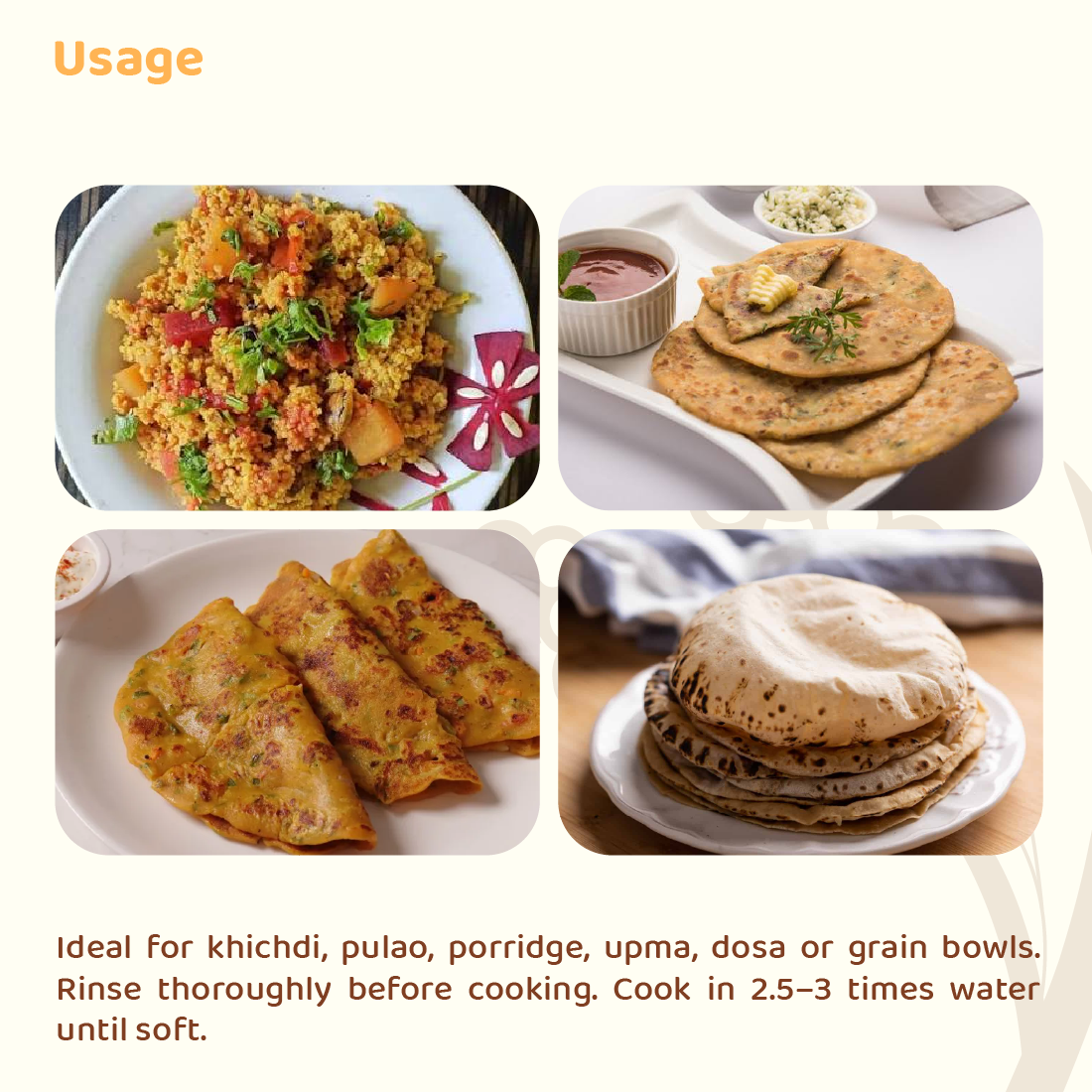
Rinse the millet, soak for 20–30 minutes, and cook with a 1:2.5 grain-to-water ratio. It cooks just like rice in 15–20 minutes.
Unpolished Kodo retains its bran layer with most of the fibre and nutrients intact. Polishing removes this layer and significantly reduces nutritional value.
Yes. Kodo millet is light, easy to digest, and safe for daily consumption as a healthy alternative to rice.
The Wellness Choice That's Right for You
 Kodo millet (Kodo)
 |
 Foxtail millet (Kangani)
 |
 Little millet (Kutki)
 |
 Barnyard millet (Sanwa)
 |
 Browntop millet (Hari Kangani)
 | |
| Grain colour | Brown | Yellow | Muddy white | Muddy white | Light green |
| Flavour | Slightly bitter, acrid | Sweet | Sweet | Sweet | Slightly astringent |
| Nutritional value | High fibre, rich in antioxidants | High protein, high iron | High fibre | Highest iron, high fibre | Highest fibre, high niacin (B3) |
| Cooking process | Rinse, soak for 6–8 hrs. Cook 1:3, ~20 min. | Rinse, soak 4–6 hrs. Cook 1:2.5 (millet:water), ~15 min. | Rinse, soak 4–6 hrs. Cook 1:2.5, ~15 min. | Rinse, soak 4–6 hrs. Cook 1:2.5, ~12–15 min. | Rinse, soak for 6–8 hrs. Cook 1:3, ~20 min. |


